Tina Sullivan · 29 September 2026
Container Orchestration Techniques for Python Web Frameworks in Enterprise Cloud Setups
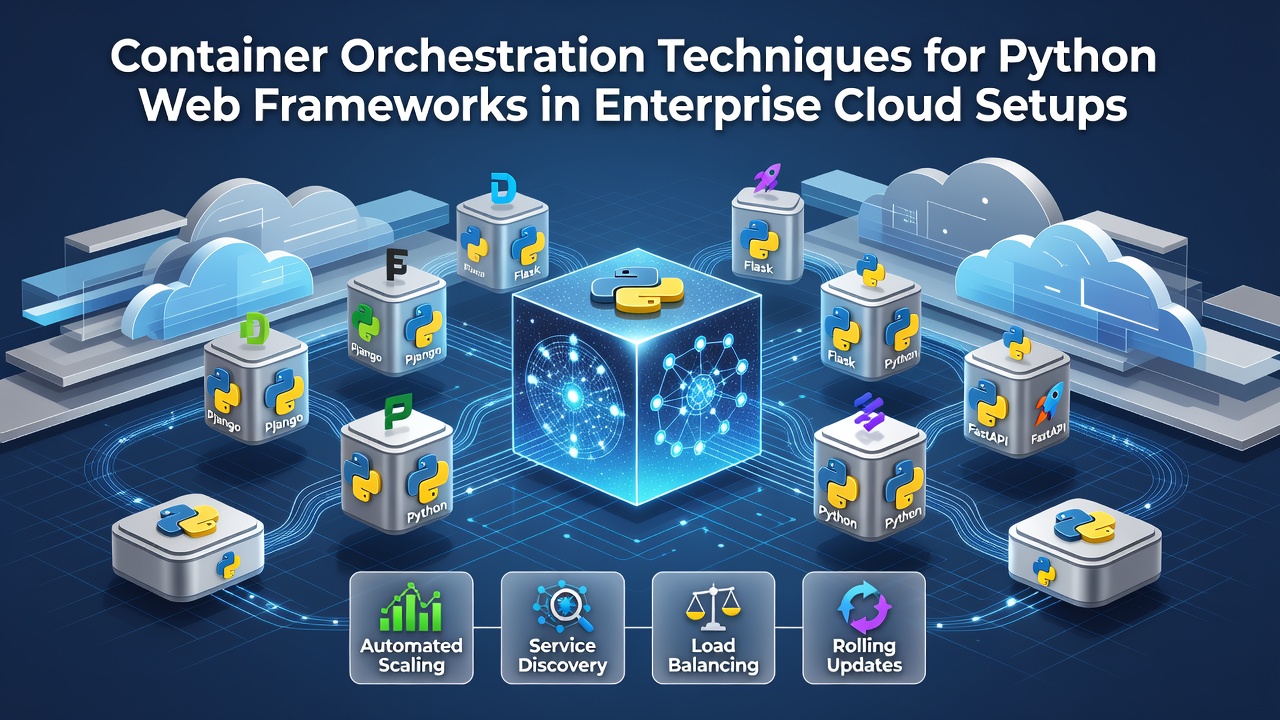
Container orchestration has become central to managing Python web frameworks such as Flask, Django, and FastAPI when organizations scale applications across enterprise cloud platforms, and researchers tracking adoption rates note that companies increasingly rely on automated systems to handle deployment consistency and resource allocation. Data from industry reports shows that by September 2026 Kubernetes distributions will incorporate enhanced Python-specific tooling for managing worker processes and connection pooling within containerized environments.
Enterprises begin by packaging applications into Docker images that include the Python runtime along with dependencies declared in requirements.txt files, while configuration management tools ensure environment variables and secrets remain synchronized across development, staging, and production clusters. Observers note that this approach reduces configuration drift because each container starts from an identical base image built through multi-stage Dockerfiles that separate build-time compilation from runtime execution.
Core Orchestration Platforms and Their Integration Patterns
Kubernetes serves as the dominant platform because it provides declarative configuration through YAML manifests that define deployments, services, and ingress resources for Python applications, yet many teams also evaluate lighter alternatives such as HashiCorp Nomad when operational overhead must stay minimal. Research indicates that Nomad clusters integrate directly with Consul for service discovery, allowing Python microservices to locate each other without additional sidecar proxies in some setups.
Teams configure horizontal pod autoscalers that monitor CPU and memory metrics collected by the metrics-server, while custom metrics adapters expose application-level signals such as request latency or queue depth gathered through Prometheus exporters embedded in the Python code. Studies have found that combining these autoscalers with cluster autoscalers on cloud providers like AWS EKS or Google GKE enables dynamic node provisioning during traffic spikes without manual intervention.
Deployment Workflows and Scaling Mechanisms
Continuous deployment pipelines trigger container image builds whenever code merges into main branches, and Argo CD or Flux operators pull updated manifests from Git repositories to maintain the desired state across clusters. This GitOps pattern ensures that Python application versions remain traceable because every change passes through version-controlled configuration files rather than ad-hoc kubectl commands.
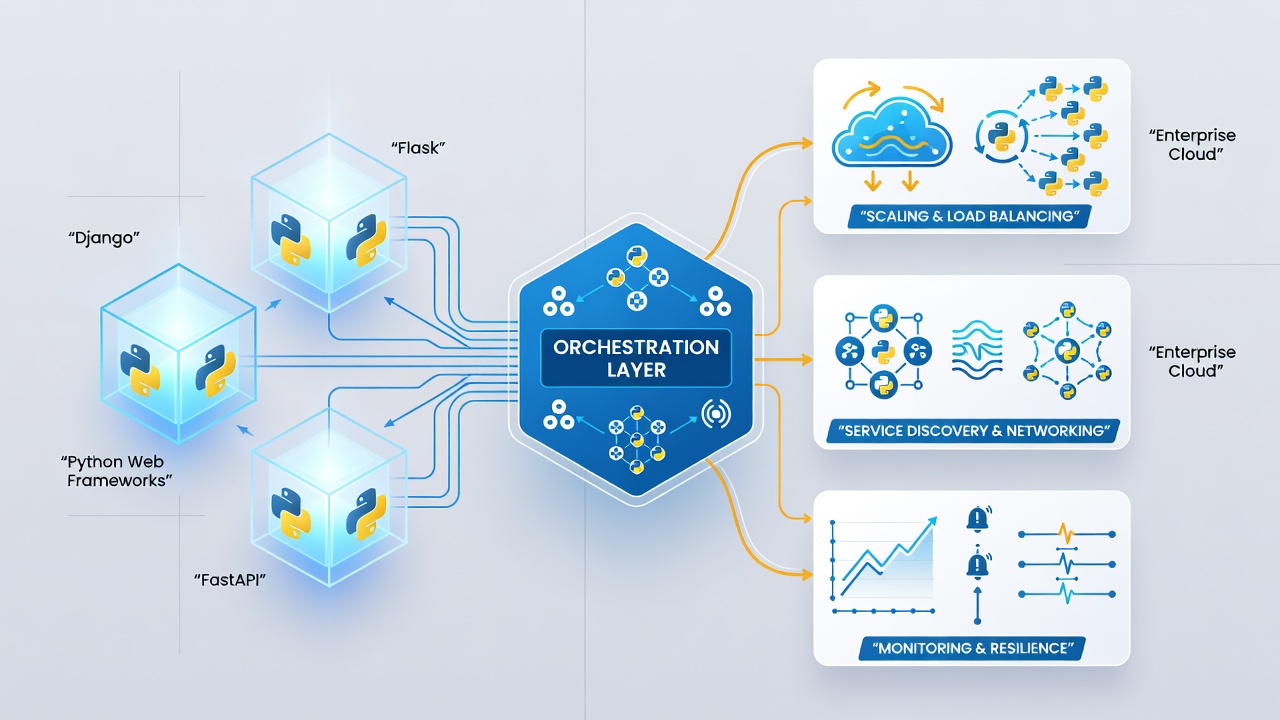
Python frameworks often run behind Gunicorn or uWSGI workers inside containers, and orchestration systems expose these processes through headless services that support sticky sessions when stateful features remain necessary. Network policies restrict traffic between namespaces so that database connections from Django applications stay isolated from public endpoints, satisfying compliance requirements documented in reports issued by the European Union Agency for Cybersecurity.
Security and Observability Considerations
Enterprise teams integrate runtime security tools such as Falco to detect anomalous behavior inside Python containers, while image scanning performed by tools like Trivy identifies vulnerabilities in base images before deployment. According to guidance from the National Institute of Standards and Technology, regular patching of container images combined with signed image verification reduces the attack surface in regulated environments.
Distributed tracing through OpenTelemetry instrumentation captures request flows across multiple Python services, and Jaeger or Zipkin backends aggregate spans so operators can identify latency bottlenecks introduced by inter-service communication. Logging aggregation via Fluentd or Vector forwards structured logs containing request IDs to centralized stores, enabling correlation during incident response.
Conclusion
Container orchestration techniques continue to evolve alongside Python web frameworks as enterprises refine their cloud strategies, and the combination of declarative configuration, automated scaling, and integrated observability provides the operational foundation required for reliable large-scale deployments. Organizations that adopt these patterns report improved consistency across environments because container boundaries enforce dependency isolation while orchestration layers manage availability and resource efficiency.