Leon Roth · 27 October 2026
Strategies for Implementing Real-Time Notifications in Python Flask Apps via Azure SignalR Service
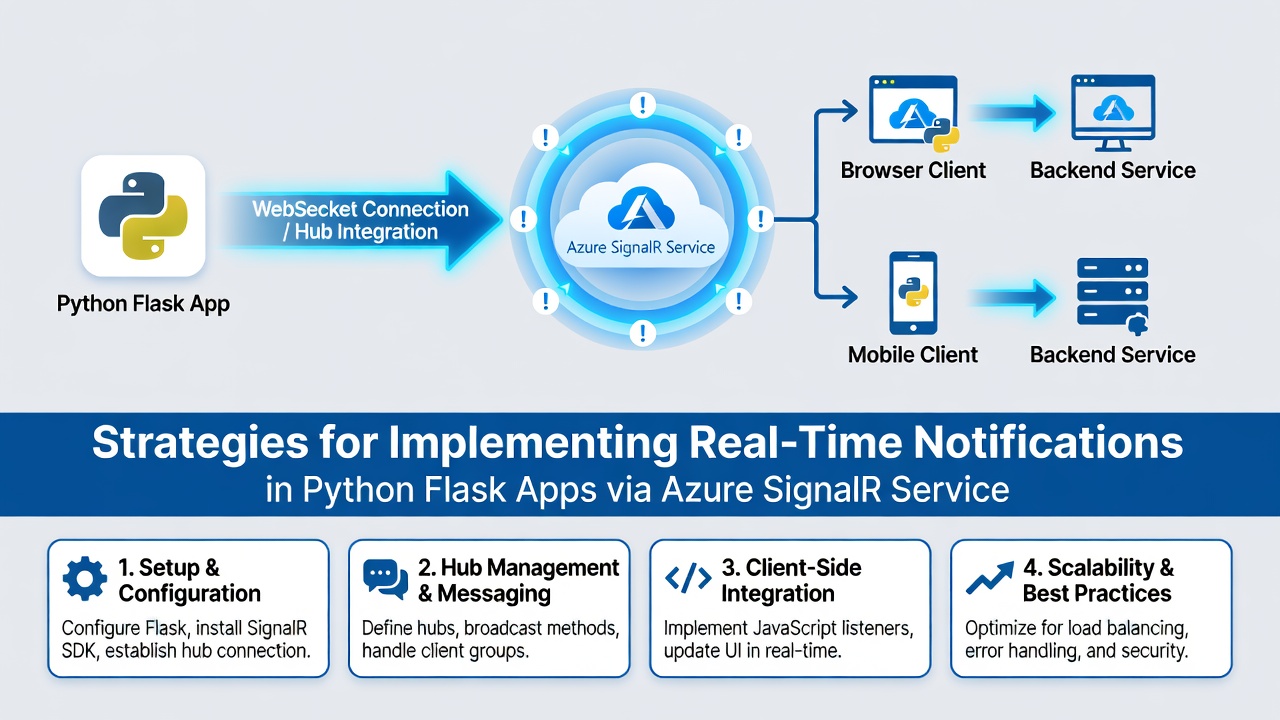
Developers building Python Flask applications frequently turn to Azure SignalR Service when they need reliable real-time notification capabilities across distributed systems, and this approach combines Flask's lightweight web framework with Azure's managed WebSocket infrastructure to deliver messages at scale. Observers note that the service handles connection management, scaling, and failover automatically, which allows teams to focus on application logic rather than infrastructure details.
Establishing the Azure SignalR Service Instance
Teams begin by provisioning an Azure SignalR Service resource through the Azure portal or command-line tools, selecting a pricing tier that matches expected connection volumes and message throughput requirements. Data from Microsoft shows that the service supports both serverless and classic modes, with serverless mode suiting event-driven Flask workloads that trigger notifications from background processes or external APIs. Configuration involves generating access keys and connection strings that Flask applications later use to authenticate and establish persistent connections.
Integrating SignalR with Flask Codebases
Flask applications connect to the service by installing the azure-messaging-webpubsub or compatible client libraries, then initializing a hub client that routes messages to specific user groups or broadcast channels. Researchers at institutions studying distributed systems have documented how developers map Flask routes to SignalR negotiation endpoints, allowing clients to obtain temporary access tokens before opening WebSocket connections. Code samples typically demonstrate creating a hub instance, defining methods for sending notifications, and handling incoming connection events within Flask's asynchronous request context using libraries such as asyncio and aiohttp.
Managing Connection Lifecycle and Authentication
Connection tokens expire after a set interval, so applications implement refresh logic that requests new tokens from Azure without dropping active sessions, and this pattern proves essential when sessions span multiple hours or days. Security teams configure Azure Active Directory integration or shared access signatures to restrict which users or roles can join specific notification groups, thereby limiting exposure of sensitive real-time data. Those who have implemented similar systems report that combining Flask's session management with SignalR's built-in group APIs reduces the need for custom state stores in many deployments.
Designing Notification Delivery Patterns
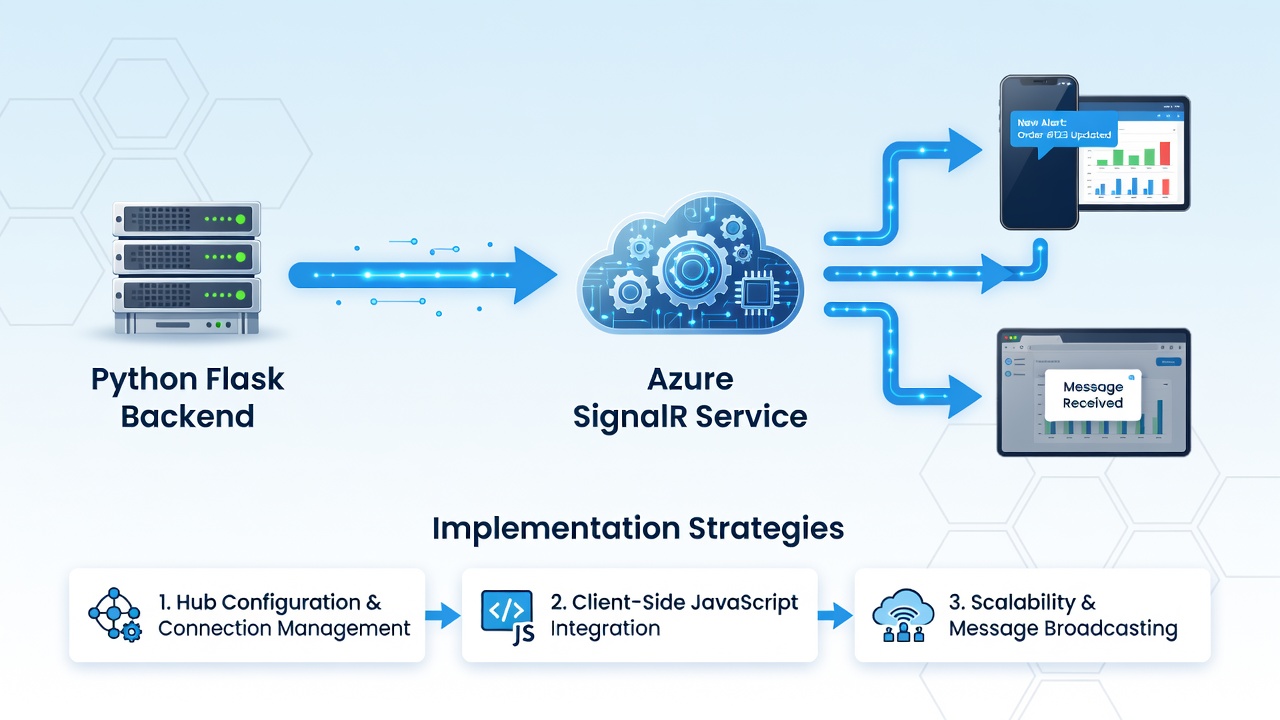
Applications choose between broadcast, user-targeted, and group-based messaging depending on use case requirements, with broadcast suitable for system-wide alerts while user-targeted messages rely on authenticated user identifiers registered with the service. Studies indicate that combining these patterns with message queuing services such as Azure Service Bus allows Flask workers to process notification triggers asynchronously before forwarding payloads to SignalR hubs. Observers have seen teams adopt JSON schemas for message payloads to ensure compatibility across web, mobile, and desktop clients consuming the same notification streams.
Scaling and Performance Considerations
Azure SignalR Service automatically adjusts capacity based on connection metrics, yet developers still monitor unit utilization through Azure Monitor to anticipate billing changes during traffic spikes. Performance benchmarks published by academic groups show that Flask applications achieve sub-second message delivery latency when SignalR units are provisioned in the same region as the primary application servers. Load testing scenarios often simulate thousands of concurrent clients to validate that negotiation, connection, and message routing remain stable under expected production loads.
Handling Failover and Regional Redundancy
Multi-region deployments pair primary and secondary SignalR instances with traffic manager profiles that redirect connections during outages, and Flask code includes retry policies that reconnect clients transparently when endpoints change. Data indicates that such configurations maintain notification continuity even when entire Azure regions experience disruptions, provided applications store connection state externally rather than in local memory. October 2026 updates to Azure's global infrastructure further improved cross-region replication speeds for real-time services, giving teams additional options for minimizing downtime during planned maintenance windows.
Conclusion
Organizations that follow structured implementation steps achieve consistent real-time notification delivery in Flask applications by leveraging Azure SignalR Service's managed infrastructure, and the combination of proper authentication, connection management, and scaling practices supports both small prototypes and enterprise-grade workloads. Continued monitoring and adherence to service limits ensure long-term reliability as notification volumes grow.