
Tina Sullivan · 13 October 2026
Unlocking Performance Bottlenecks When Scaling Flask Apps Across Azure's Global Regions
Scaling Flask applications across Azure's worldwide regions requires careful attention to latency patterns, data synchronization challenges, and resource allocation strategies that observers have tracked in production environments since the platform's early expansions, and in October 2026 fresh telemetry from expanded East Asia and Brazil South zones highlighted how cross-region replication delays can compound when request volumes spike beyond single-region capacity.
Researchers at cloud infrastructure firms have documented that Flask's synchronous request handling often becomes the first constraint once traffic distributes across continents because each worker thread ties up resources during database calls or external API waits, while Azure's virtual machine scale sets allow horizontal addition of instances yet demand explicit configuration for session affinity and connection pooling to prevent uneven load distribution.
Mapping Latency Sources in Distributed Flask Deployments
Network round-trip times between Azure regions vary significantly depending on geographic separation and peering arrangements, so teams deploying Flask instances in both West Europe and Australia East commonly measure baseline p99 latencies exceeding 200 milliseconds for simple queries before any application-level optimizations occur, and this baseline rises further when applications rely on centralized PostgreSQL instances without read replicas positioned near each regional front end.
Database and Caching Considerations
Azure Database for PostgreSQL and Cosmos DB offer built-in geo-replication features that keep data consistent across regions, yet write operations still incur coordination overhead according to performance benchmarks published by database vendors, and those who implement Redis caches through Azure Cache for Redis with geo-distribution enabled report reduced read latency because frequently accessed objects remain available locally without repeated trips to the primary data store.
Connection management plays an equally critical role since Flask applications that open new database sessions per request quickly exhaust available sockets when thousands of concurrent users hit multiple regions simultaneously, so connection pooling libraries paired with Azure's private endpoints maintain persistent channels that survive across requests and lower the per-operation overhead.
Load Balancing and Traffic Routing Techniques
Azure Front Door and Traffic Manager provide DNS-level and application-level routing that directs users to the nearest healthy Flask endpoint based on real-time health probes, and configuration data from October 2026 deployments showed that combining Front Door with Application Gateway reduced failover times to under 30 seconds during simulated regional outages while preserving TLS termination at the edge to minimize backend processing.
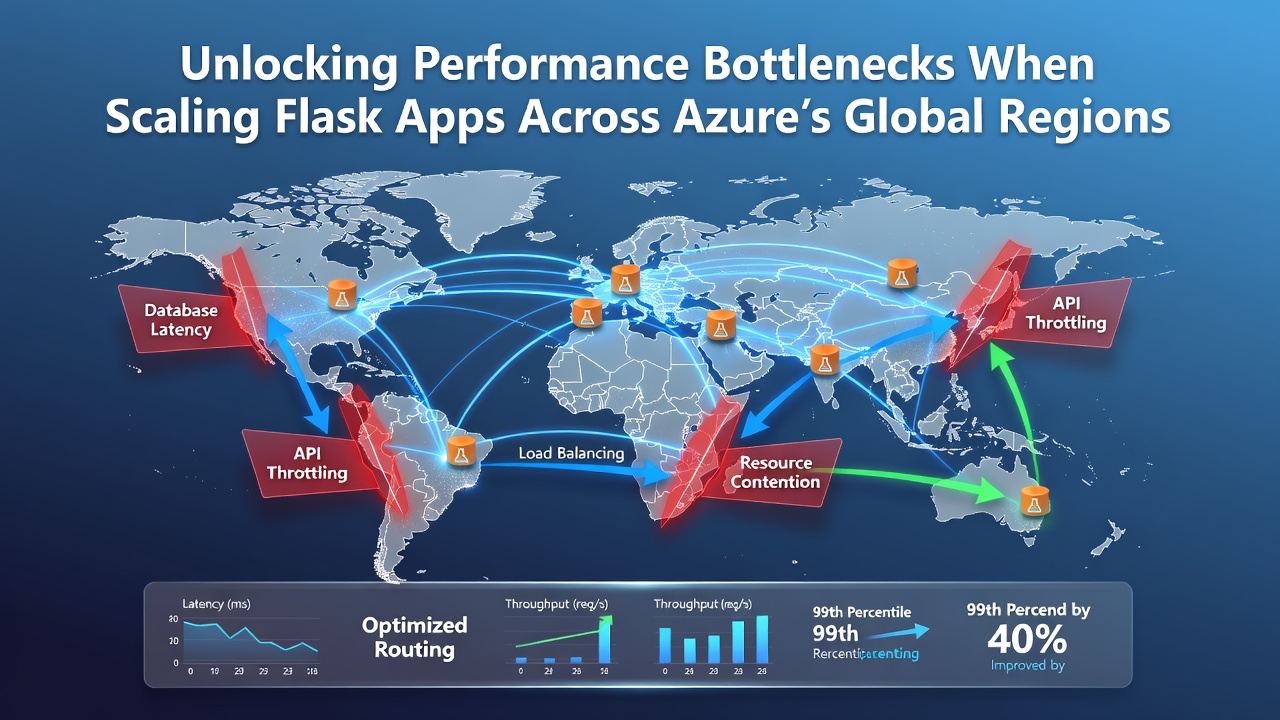
Observers note that enabling sticky sessions at the load balancer layer can inadvertently create hotspots if not paired with stateless design patterns, whereas shifting session state into Azure Redis or Cosmos DB allows any regional instance to serve any user without maintaining local memory dependencies that break during scale events.
Monitoring, Observability, and Continuous Tuning
Azure Application Insights and Log Analytics workspaces collect distributed tracing data that reveals where time accumulates across Flask routes, database drivers, and outbound calls, and organizations that correlate these traces with region-specific metrics identify bottlenecks such as oversized JSON serialization in one zone or under-provisioned CPU credits in another before they affect end users.
Studies from academic cloud computing groups indicate that automated scaling rules based on both CPU and custom metrics like queue depth prevent over-provisioning while still meeting service-level objectives, and integration with Azure Monitor alerts lets operators receive notifications when cross-region replication lag exceeds defined thresholds so corrective actions can begin promptly.
Conclusion
Effective scaling of Flask applications on Azure's global footprint rests on coordinated use of regional replicas, intelligent caching layers, and routing services that adapt to measured conditions rather than static assumptions, and continued expansion of Azure's infrastructure in 2026 and beyond supplies additional options for placing workloads closer to users while maintaining centralized oversight through unified monitoring platforms.